

[I originally wrote this post for the Institute for Christian Studies (ICS) in Toronto. On October 8 at 7pm (Eastern), ICS will feature my new book Defying Tyrants: Following Jesus in a World of Christian Antichrists in their Big Read series. You can sign up for that event here.]
All around us the name of Jesus is invoked by government officials and Trump-aligned clergy in a cacophony of blasphemy. Department of Homeland Security propaganda videos quote the Sermon on the Mount, “blessed are the peacemakers,” overlaid on scenes of CBP and Coast Guard agents brandishing weapons and rounding up migrants. Our Secretary of Holy War casts our profane president in the role of Jesus while jeering that “the legacy Trump-hating press” is “just like these Pharisees.” Trump’s own in-house televangelist Paula White-Cain compared the hustler-in-chief to Jesus himself — at an Easter event! — noting that both men had been “betrayed and arrested and falsely accused.” They parade around on the National Mall, rededicating the nation to God and ostentatiously insisting that their Christian nationalism will help “proclaim the name of Jesus.”
Can’t you picture Jesus (quoting his favorite Hebrew prophet) proclaiming Isaiah back to them:
Stop bringing meaningless offerings!
Your incense is detestable to me.
New Moons, Sabbaths and convocations—
I cannot bear your worthless assemblies.
Your New Moon feasts and your appointed festivals
I hate with all my being. (Isaiah 1:13–14)
These are the Christian leaders who wield power over the executive branch of our government, as well as sizable caucuses in both houses of Congress, and more than a couple seats on the Supreme Court. They bastardize the name of Jesus every time they invoke him. They disdain the way of living he taught and the kingdom he preached.
What I find missing in most of the American church is any sense of the radical and revolutionary politics of Jesus. Even apart from this crowd of sycophantic regime-blessers, when I listen to other American pulpits, I hear not so much nationalistic blasphemy as banal commentary and the outfitting of Jesus to ride each preacher’s hobby horse. We hear “What Would Jesus Do?” bandied about as a cliché, and arguments abound about how to apply Jesus’s teachings to every personal behavior and every sexual and private aspect of our modern lives, but when it comes to our politics, how we negotiate power as a society, we bizarrely act like the colonized preacher who was executed by the occupying empire as an insurrectionist was somehow politically neutral or simply had nothing to teach us on that front.
Jesus’s politics are counterintuitive, and they do not map neatly to any modern ideology, so I will do my best to describe his vision of power and relationships succinctly, but if you want to go deeper, pick up my new book, Defying Tyrants: Following Jesus in a World of Christian Antichrists. Part of the argument of that book is that this contemporary invoking of Jesus for the sake of one’s own power is what the early church labeled “the spirit of antichrist,” blessing Jesus’s name while betraying his way. But the other throughline of the book is calling Christians (those who name themselves followers of Christ) to reconsider and reattempt the radical political vision that Christ taught and practiced.
Jesus lived and the early church grew up during what was called the “Pax Romana,” the Peace of Rome. Like DHS labeling its goons “peacemakers,” these are the sorts of euphemisms that brutal empires use: Rome’s “peace” meant unfathomable suffering for others. The Roman Empire was a pyramidal hierarchy, with Caesar and the ultra-wealthy at the pinnacle, sloping down through layers of violence and cruelty. In Roman Italy, perhaps one in five people was enslaved. Roman values of domination and dignitas (rank) meant that every relationship was hierarchical: Caesar over everyone, men over women, the pater familias over the household, master over slave. At the very bottom of that pyramid were the enslaved and the colonized, including Jesus and most of the people we read about in the New Testament, those crushed under Caesar’s bootheel.
The fact that he lived under tyranny, which has been true for most humans throughout history, makes Jesus even more representative of humanity writ large, almost a perfect median of human experience. He was a colonized man, living under the thumb of a merciless emperor, among communities taxed to starvation and threatened regularly with indiscriminate violence.
Understood against this backdrop, the life of Jesus appears much more starkly human and fragile. He perpetually bucks against the Roman imperial system. Jesus, the colonized God, walks among humanity touching and healing and blessing and feeding the Galilean bodies crushed by Caesar’s heartless oppression.
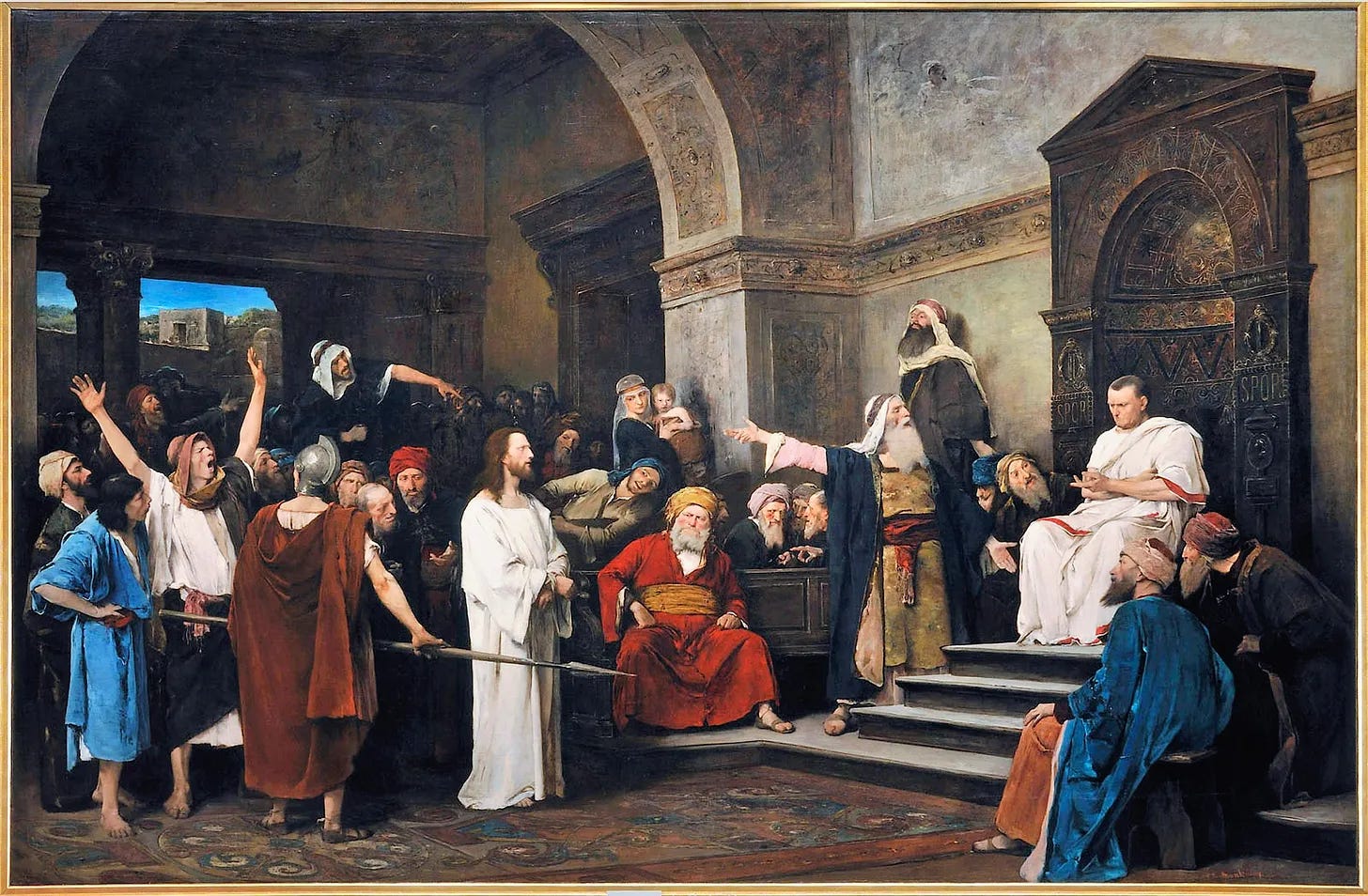
Jesus’s politics were almost insanely defiant toward the colonial powers. That’s why his fellow colonized Galileans and Judeans react to him the way they do. He sends a message to Herod, one of Caesar’s local cronies, “Go tell that fox…” I argue in my book that Jesus’s often misread statement “Render to Caesar the things that are Caesar’s and to God the things that are God’s” is a radically subversive message when you understand the integration of Roman coinage and the imperial practice of worshiping Caesar. I love Jesus’s coyly defiant response when Pilate asks him if he’s the “king of the Jews.” He retorts, “Is that your own idea or did others talk to you about me?” Who claps back at tyrants like that other than Jesus? As the King James Bible so marvelously translates the Apostle Peter, “God is no respecter of persons.” Neither is God Incarnate.
The Jesus of the Gospels is a rampaging disrupter of hierarchies. He interacts with women (some of them scandalous) in ways that are culturally inappropriate. He gets in trouble for being drinking buddies with the most ill-reputed members of society: the tax collectors and prostitutes. He reorients his disciples to an inverted order where the last shall be first and the first shall be last.
In fact, read in context, the core teaching of Jesus that he called the “kingdom of God” is a direct inversion of Caesar’s kingdom. In Caesar’s kingdom, the distant emperor demands that others suffer for the sake of his power and luxury, but Jesus, the peasant king, dwells among society’s rejects, giving abundantly to every human being he meets. In Caesar’s kingdom (as in Trump’s), might makes right and violence is the tool for enforcing hierarchy, but Jesus puts himself between the empire and the people, absorbing the violence of the empire into his own colonized body, and ransoming it for love.
The politics of Jesus might best be described as profoundly egalitarian and theologically anti-authoritarian. Amid the dehumanizing horrors of Caesar’s false peace, Jesus lives a campaign of humanization, of rehumanization. He is morally and mortally opposed to the abuse of power and to any notion that lifts some of humanity above others. He summons his followers to be the slave of all, to choose downward mobility, to defy the Roman quest to climb the pyramid of domination, and instead to serve and care for the least of these — the poor, the outcast, the blind, the lame, and the imprisoned — the people crushed under Caesar’s despotism.
What would it look like to try to live the politics of Jesus today? No ancient kingdom, medieval empire, early modern nation-state, or modern political party has ever made an honest attempt to follow the politics of Jesus, because Jesus’s vision is so utterly subversive that it undermines the very quest for advancing one’s own interests that is at the heart of organized politics. What kingdom or nation or party loves its enemies? What political coalition or self-respecting political party would ever put others first, give up power? There has never been a “Christian nation,” if by Christian we mean Christlike. But there have been many antichrist ones.
To live by the kingdom of Jesus in the empire of Caesar is to defy the authoritarian claims of megalomaniacal presidents and monomaniacal pastors alike. It is to marginalize yourself within much of institutionalized Christianity, which has become obsessed with hierarchy and power. It is to clearly see Christian nationalism and Christian supremacy as blasphemous lies from the pit of hell. It is to object to the abuse of power — both within the church and in the world — with every fiber of your being.
The North Star of the politics of Jesus is found by asking: who are the people that society disdains, and how do we care for them? Who is claiming superiority and supremacy over others and needs to be rebuked? Who is suffering under heavy burdens that must be lifted? To live our lives by these questions is to join Jesus’s conspiracy against all human hierarchies.
There have certainly been Christians who have aimed to follow the nonviolent but subversive, radically egalitarian and unswervingly anti-authoritarian way of Jesus. They were often persecuted by other Christians who were, like the Trumpian crowd, obsessed with their own power and supremacy.
The politics of Jesus will never be “popular.” They’ll never get majority support, even in a population made up entirely of Christians. They push us to stand against tyranny, defying wannabe autocrats and their blaspheming toadies, but they also summon us to the margins, to put ourselves between the empire and the people. The politics of Jesus, if we were actually courageous enough to try them, might be the very antidote to the authoritarian, spiteful, sacrilegious MAGA Christian politics of today.
What a powerful piece! Eager to read your book! Would love to see you interviewed across mainstream media and podcasts for your book. The nation - the world - needs to hear and absorb the TRUTH in your message. 🙏♥️
I am so glad you ended the piece as you did. To recognize that the call of Jesus is not to a new idealized kind of supremacy, and that it was not intended to be that (apart from the promised return of the King himself, which offers much more than simple egalitarianism), echoes all that I have read and studied in both the Old and the New Testaments. When we look at the straights in which the early struggled to live and witness in the midst of oppressive political power, the integration of religion into society’s structures, and the application of these structures by and through forms of patriarchy, one gets the picture of a church looking toward ultimate deliverance, and not so much immediate change of power dynamics. The early church did, I think, subversively attempt to change some of those dynamics. But that was to bring hope within their constraints, not revolution. Or so I read the texts. I’m looking forward to reading your book!