

[This is the third in my series of excerpts from my forthcoming book, Defying Tyrants: Following Jesus in a World of Christian Antichrists. The overarching argument of the book is that Jesus and the early church were deeply anti-authoritarian and held a subversive “first shall be last” vision of human society. In the final section of the book, I turn to one of the most potent prooftexts that has been weaponized by Christians to claim un-Christlike power over others: the book of Revelation.]
The future we hope for steers the steps we take. Indeed, how we imagine the future becomes our inner helmsman: the hand at the wheel guiding us. Eschatology is ethics. So it is a matter of immense importance how we imagine the end of the world—or at least the end of our world. What eternity we imagine ourselves living matters a great deal for how we live now.
When I speak against Christian supremacy in churches or other venues, a Christian in the audience often asks: “But you’re a Christian. Don’t you believe that Christ is supreme? I mean, there’s only one King and Lord, and, in the end, when all is revealed, ‘every knee will bow’ (Philippians 2:10). Isn’t Christ’s ultimate supremacy definitional to Christianity?”
It’s both a stimulating and a flummoxing question. On the one hand, yes, many passages in the Bible—mostly in the Old Testament but some in the New Testament too—appear to cut against this nondominating vision of God we’ve been excavating from the ruins of Christian empires. This is particularly true when we get to how the various New Testament authors envision the future, the final judgment, the battle of Armageddon, and so forth. So it’s fair to ask: Can we truly reconcile a generous, merciful, self-sacrificing vision of God with the God of the Christian eschaton (Greek for “the last things”)?
On the other hand, it’s always disorienting to me how easily Christians can leap from Jesus, the sharp-witted but inordinately compassionate peasant preacher who willingly went to the cross and taught us to love our enemies, to Jesus, the conquering warrior come to crush his enemies under his feet. When exactly did Jesus undergo this violent, manic personality transformation? When it comes to the end times, many Christians who might otherwise profess their belief in a loving, compassionate God and espouse love for all their fellow humans are also quite content to anticipate and even celebrate a God who dominates, tortures, and conquers those fellow humans with a vengeance.
This conundrum is not unique to Christians, of course. Many humans relish imagining ideological vindication in the end, when all is revealed, as if one-upmanship, competition, and being right were the point of being human. I have encountered many, many people who would rather be right than humane. I’d wager that, in the end, when all is revealed, they will be found to be neither.
Speaking of revealed: The book of Revelation is the key biblical text that straddles this disjuncture between Jesus as gentle servant and Jesus as supreme end-times conqueror. It is one of the most controversial texts of the Bible, the stuff of high-budget disaster action movies and apocalyptic death cults. Here the wrath of God is poured out upon the earth. Here God brings history to a close with a bang.
Revelation is the lone New Testament exemplar of a predominantly Jewish literary genre from the ancient world: apocalyptic literature (apokalypsis). As a genre, it is a literature of trauma—communal psychological processing cagily encoded as eschatological vision. Hence, from the reader’s perspective, apokalypsis is a wild ride. And Christians, in nearly every generation, have tended to read the vivid, stormy, disruptive imagery of Revelation willy-nilly.
Human brains are hardwired to find patterns and connect dots, and it’s easy for us to free-associate to whatever the text brings to mind. We often read our own times back into the biblical stories and symbolism. But this entire text of the book of Revelation is part of an ancient cultural commentary tradition, one built around systems of symbol and allegory. Revelation is a codebook for which we—by which I mean most Christians across many centuries—have lost the cipher.
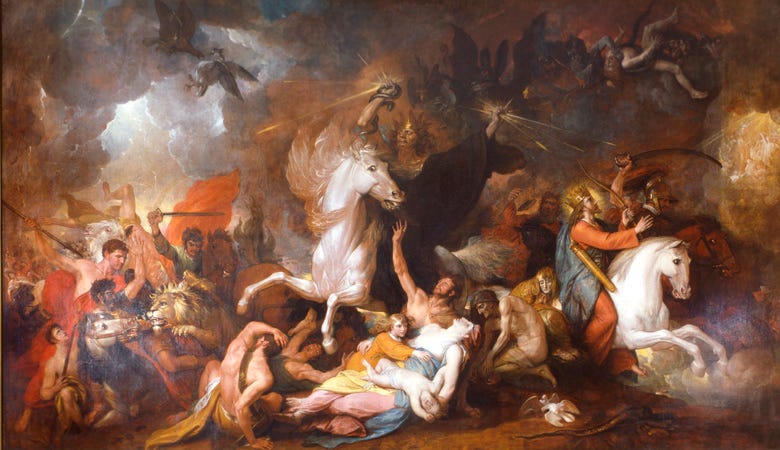
So many of the scary fantasies of the Christian supremacists throughout history take their scriptural root from this bewildering text. It is in Revelation that Jesus is declared the Lion of the Tribe of Judah, come to rule the nations of the earth with an iron scepter (Revelation 5:5, 19:15). Here Jesus is depicted as the apocalyptic rider on the white horse with a sword extending from his mouth to slaughter the enemies of God. Here is the famous image of Jesus treading the winepress of God’s wrath (Revelation 19:11–21).
And if you survey the breadth and depth of Christian art throughout the centuries, you will quickly see the degree to which Revelation has shaped the collective Christian imagination. There’s something visceral about this text—the cosmos-in-chaos vibes, the vengeance of it all—that has elicited the fears and hopes of countless Christians. Both attracted to and repulsed by violent visions of the eschaton, many believers become obsessed with this biblical exclamation point on human history.
So do my Christian interrogators raise a fair objection when they suggest Christ’s supremacy and dominance are definitional to Christianity? Or as those more critical of Christianity might frame it: I get all this incarnation, God-as-servant, subverting-the-dominant-order stuff. But doesn’t Revelation suggest Christ is just another Caesar in the end, bent on imposing his imperial will on humanity?
These are valid questions, as the cruel and dominating antichrist history of Christianity makes all too abundantly clear… But at the same time, no hermeneutical tiptoeing around Revelation will get us off the horns of this dilemma. From the pearly gates to the whore of Babylon, from the mark of the Beast to the New Jerusalem, the Christian tradition is shot through with the imagery and theology of Revelation.
So across the three final chapters of this book, I will draw out the theme of empire and power in Revelation, situating it in its original context and decoding some of the cryptic imagery for which we really do have good answers. We will ask the question: How do you hold together the judgment of God with the kindness and kinship of God?
Along the way, I will attempt to reconcile the Jesus of the Gospels, Acts, and the Epistles with the Jesus of Revelation, for I believe that there is a deep resonance between these biblical portrayals of Jesus, alongside an abiding tension. While we cannot deny the starring role of Jesus in Revelation, his resolute wrath and his final judgment of humanity, we must attend to the imperial objects of Jesus’s wrath if we are to understand the meaning of this apokalypsis. In the kaleidoscopic vision of this text, it is the primacy of Jesus’s identity as the Lamb that tempers and directs the wrath of God, not against humanity per se but against the kingdoms of this world: the regimes of power and dominance that have colonized people groups, enslaved human beings, and desecrated God’s good creation. The sublime passages that bring our Bibles to a close cannot come to pass until God’s inverted kingdom unseats all the regimes that have held God’s children in thrall these many millennia.
But first we need to grapple with where the text of Revelation came from and how it came to be in the back of our Bibles. How did this science fiction text become part of a library that otherwise comprises personal correspondence, communal histories, and biographies? It is a question that has occasioned no shortage of controversy in Christian history.
Wow what great trailer -revelations on the surface seems fo be such a contradiction. However with perception and allowing it to live in its time and space it aligns. I am looking forward to this book!
"Deep resonance" yet "abiding tension" between the Jesus of Revelation and the Jesus of the rest of the NT. I think that is well-stated and I'm eager to see how you develop this theme in your book.